Wadi Shees Nature Trail: 1.8 km Loop, Free Entry & Parking
Running water is the reason to walk the Wadi Shees Nature Trail. For most of the loop, a falaj (an irrigation channel about 3,000 years old) runs beside the path between date palms and terraced farms, in a country that receives under 100 mm of rain a year.
The walk needs no ticket or booking, and the trailhead sits a few minutes’ drive below Shees Park in Sharjah’s Hajar Mountains, near Khorfakkan.
Wadi Shees Nature Trail visitor information
| Detail | Information |
|---|---|
| Distance | 1.8 km loop |
| Walking time | 30 to 40 minutes |
| Entry | Free, no booking or permit |
| Trailhead parking | Free, beside the information board at the start of Shees village |
| Surface | Stone steps, village paths and a short road section |
| Toilets | None on the loop; the nearest are at Shees Park |
| Drive time | About 45 minutes from Sharjah city, 60 to 90 minutes from Dubai |
| Swimming | Not allowed |
Why the valley has flowing water

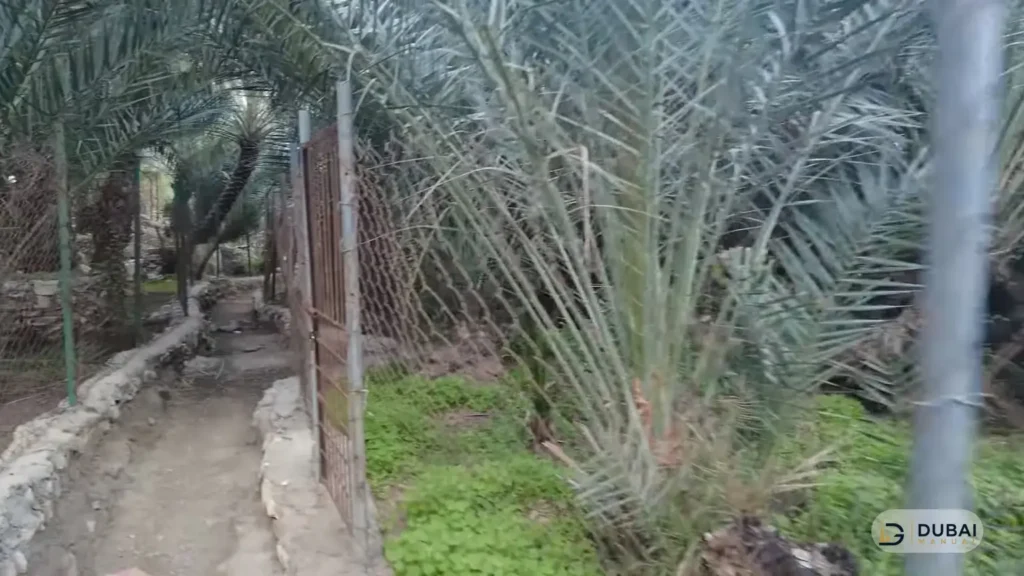
The falaj carries rainwater from the surrounding mountains down to the village farms, and it still does that job today. Date palms, terraced fields and the green strip along the path all exist because of that one channel.
Shees was once a lived-in farming settlement, and part of the old village is still used by local farmers. That is why the loop feels more like a walk through a working valley than a managed attraction, with no gate, ticket desk or ranger station along the way.
How the loop runs
The loop starts at the information board by the trailhead parking, climbs into the old village of Shees, follows the falaj past farms and palm groves, and drops back to the road.
- Read the information board at the start. It shows the route map and gives the history of the valley, including the settlement of the Naqbi tribe.
- Climb the stone steps. At the top, the date palm canopy opens out with the Hajar Mountains behind it.
- Walk through the old village. Farmers still work here, so keep to the marked path and treat the houses and fields as private.
- Follow the falaj. The path runs beside the channel for long stretches and crosses over it in places, so running water is audible for most of the walk.
- Descend the last steps to the road and walk a short way back to your car.
Parts of the route have uneven ground and stairs, so the loop is not step-free and does not suit strollers or wheelchairs. Palm trees shade some sections, but there are no major rest spots, which makes it a single continuous walk rather than a trail with places to stop. Native plants and animals turn up near the water.
Is the drive worth it for a 40-minute walk?
The loop is short, so the drive decides how big the day is:
- From Sharjah city: about 45 minutes each way, so the trail plus Shees Park fits into a half day.
- From Dubai: 60 to 90 minutes each way, which is 2 to 3 hours of driving for a 30 to 40 minute walk. It earns that time when combined with Shees Park and Al Rafisah Dam.
The trade-off is plain. You get constant flowing water, a heritage village and easy walking, but no sustained climb and no summit view. Anyone after a proper hike will find the loop too gentle on its own.
How to get there
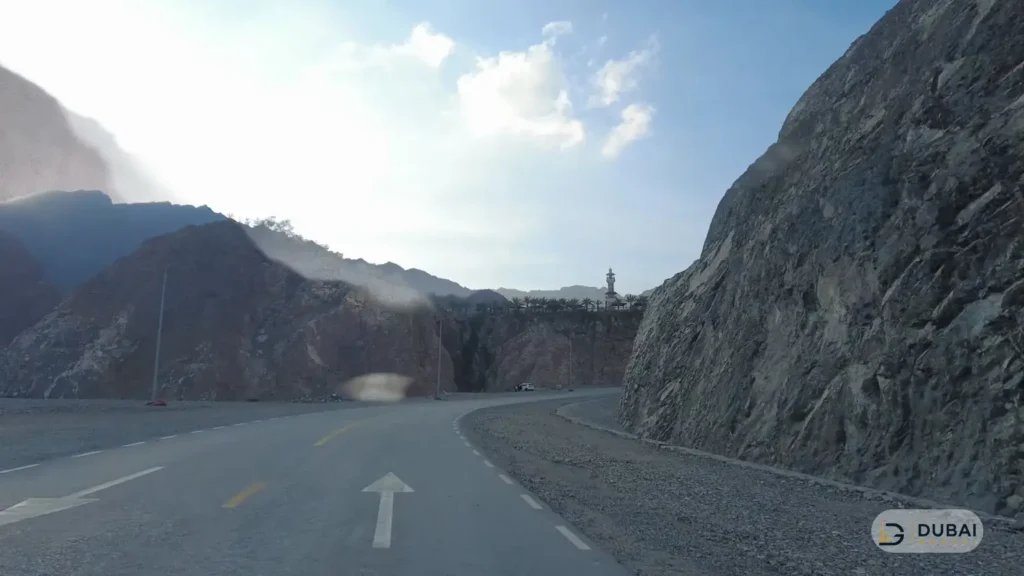
Drive via the S142, the Sharjah to Khorfakkan road, and exit for Wadi Shees just after the first tunnel.
- Take Emirates Road (E611) east and join the S142 towards Khorfakkan.
- Pass through the first tunnel.
- Take the right-hand exit for Wadi Shees just after the “Welcome to Khor Fakkan” sign.
- Drive past Shees Park, then follow the road downhill for about five minutes into Shees village.
- Park beside the information board where the trail starts.
Set your navigation to the Shees Park map pin before leaving the highway, since the trailhead sits a few minutes’ drive below the park.
Parking
Free parking is available beside the information board at the trailhead, and more at Shees Park uphill. The trailhead spaces fill quickly on busy days. When they are full, leave the car at Shees Park and walk down the road, which takes about 20 minutes.
The last stretch before the village is gravel, but a standard 2WD car handles it. A 4×4 is not needed.
Without a car
No public bus serves the valley. Intercity buses stop in Khorfakkan town, about 25 minutes by road from Wadi Shees, and a taxi covers the rest. A taxi from Dubai or Sharjah avoids the transfer, but agree the return fare before you set off.
What to bring
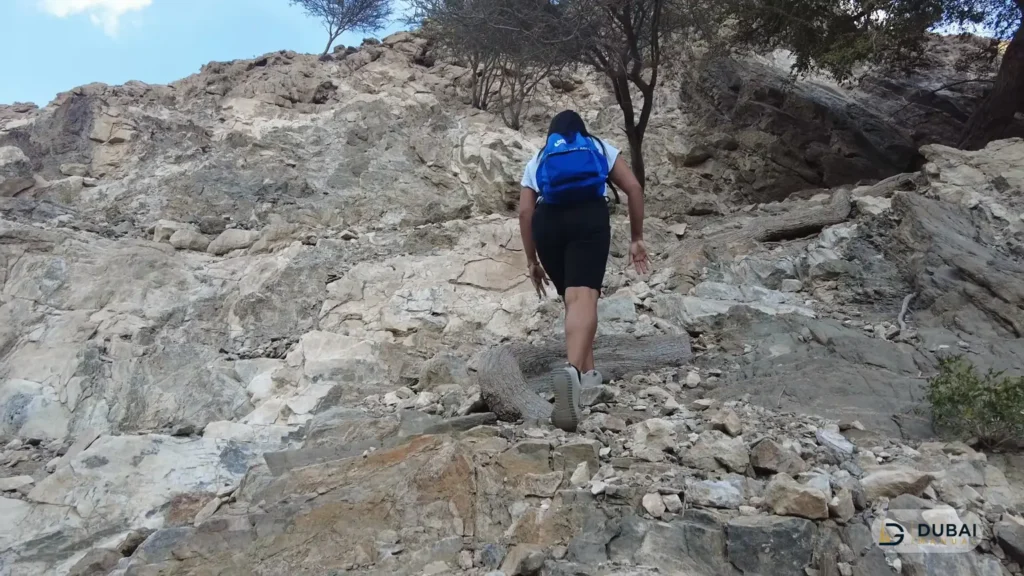
- Water and snacks, since there are no rest stops on the trail.
- Sneakers or light trail shoes with grip. Hiking boots are optional, and sandals struggle on the steps and rocky patches.
- A hat, sunglasses and sunscreen, because the palms only shade parts of the loop.
- Clothes that cover shoulders and knees, as the path runs through a lived-in village.
- A small first-aid kit with plasters and insect bite ointment.
- A bag for rubbish.
Rules & safety
- Do not swim in the channels, pools or reservoir. The falaj is a working irrigation system that feeds the farms.
- Stay on the marked path and out of private farms and homes.
- Take all rubbish with you. There are no bins on the loop.
- Skip the valley when rain is forecast in the mountains. Wadis can flood quickly, and flash floods are the one serious hazard here.
- Mobile signal is usually available along the route, and the information boards mark the way.
Best time to visit
October to April is the best window, in the morning or late afternoon. Cooler air makes the exposed stone steps comfortable, while summer midday heat builds fast in the open sections.
Weekends and public holidays are the busiest days, and the trailhead spaces go first. Shees Park opens at 8 AM, so an early start gets you a parking space and a quiet loop. Treat the loop itself as a daylight walk, even though the park stays open until 10 PM.
Is Wadi Shees family friendly?
Yes. At 30 to 40 minutes it suits children and older walkers, and the water channels hold most children’s attention for the whole route.
Two things need attention. The stone steps and open channels call for close supervision of young children, and the loop cannot take a stroller. Shees Park has toilets and free drinking water, so stop there before driving down to the trailhead.
Stops to add to the walk
- Shees Park is free and open daily from 8 AM to 10 PM, with a 25 m waterfall, toilets and a Gerard Café branch. Pets, swimming and camping are not allowed.
- Al Rafisah Dam is a short drive away, with kayak rentals from AED 40.
- The gravel road out of Shees village leads to a small border sign on a rock marking the edge of Madha, an Omani enclave.
- For a harder day, the Al Rabi hiking trail in Khorfakkan is a climb to an old watchtower that takes a few hours.
FAQ
Is the Wadi Shees Nature Trail free?
Yes. The loop has no entry fee, ticket desk, booking or permit, and parking at the trailhead and at Shees Park is free.
How long is the Wadi Shees Nature Trail?
The marked loop is 1.8 km and takes 30 to 40 minutes at an easy pace.
Where is Wadi Shees?
Wadi Shees is in the Shees Valley in the Hajar Mountains of Sharjah, near Khorfakkan, just off the S142 Sharjah to Khorfakkan road.
Are there toilets on the Wadi Shees trail?
No. The loop has no toilets, and the nearest ones are at Shees Park, a few minutes’ drive uphill from the trailhead.
Can you swim at Wadi Shees?
No. Swimming is not allowed in the falaj channels, pools or reservoir, because they irrigate working farms.
Do you need a 4×4 for Wadi Shees?
No. The road to the trailhead turns to gravel near the village, but a standard 2WD car manages it.
Plan your Wadi Shees day
- Leave Emirates Road for the S142 and take the Wadi Shees exit just after the first tunnel.
- Arrive in the morning, particularly at weekends, to get trailhead parking.
- Use the Shees Park toilets and fill your water bottle there before you walk.
- Pack sneakers, sun protection and a bag for rubbish.
- Check the rain forecast for the mountains and choose another day if rain is expected.